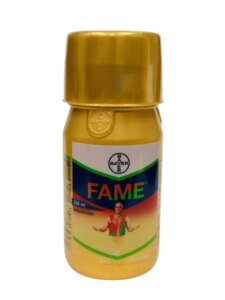
Bayer FAME Flubendiamide 480 SC (39.35% ww) Insecticide acts on the Nervous System. Flubendiamide Disrupts Proper Muscle Function in Insects.
₹1,410.00
Send EnquiryDescription
Bayer Fame Flubendiamide 480 Sc (39.35% W/W) Acts On The Nervous System, Flubendiamide Disrupts Proper Muscle Function In Insects. Fame Contains Flubendiamide, The First Representative Of A New Chemical Insecticide Class—The Diamides. In Contrast To Other Insecticide Classes Targeting The Insect Nervous System, Flubendiamide Acts At Receptors In Insect Muscles, Causing Immediate Cessation Of Feeding And Thus Avoiding Crop Damage. It is well-suited for Controlling A broad range of lepidoptera pests. The compound’s Unique Mode Of Action Makes It Well-Suited as a tool in insect resistance management programs. Features And Benefits: Control Of A Broad Range Of Lepidoptera Pests. – Pronounced Larvicidal Activity, The Product Has To Be Ingested – No Ovicidal Activity Fame Is Fast-Acting And Leads To A Rapid Cessation Of Feeding Immediately After Ingestion Of The Compound Fame’s Unique Mode Of Action Makes It An Excellent Tool For Resistance Management Programs And IPM Due To Its Favorable Toxicity Profile. Rain Fast Due To Specific Physicochemical Properties It Is Non-Toxic To Adult Honey Bees (Ld50 Greater Than 200 Μga.S./Bee For Acute Oral And Contact Exposure). Likewise, Does Not Pose A Risk To Beneficial Insects Such As Parasitoids, Predatory Mites, Or Foliage-Dwelling Insect Species Flubendiamide Sc 480 Is Generally Well Miscible With Conventional Crop Protection Products. In Particular Cases, Miscibility Tests Should Be Performed Before Application. Always Refer To The Product Label For Details. Mode Of Action: In Contrast To Most Commercially Successful Insecticides, Which Act On The Nervous System, Flubendiamide Disrupts Proper Muscle Function In Insects And, Therefore, Represents A Novel, Unique Mode Of Action. These Characteristic Symptoms Are Induced By Flubendiamide Through The Activation Of Ryanodine-Sensitive Intracellular Calcium Release Channels (Ryanodine Receptors, Ryr) As Shown By Ca2+ Fluorescence Measurements In Insect Neurons As Well As In Recombinant Cells Expressing The Cloned Ryanodine Receptor From Drosophila Melanogaster. Crop: Cotton, Rice, Chillies, Tomato, Cabbage, Pigeon Pea, Black Gram, Brinjal. Dosage: 2 – 5 Ml
Reviews (0)
No reviews yet.